
The average person checks their phone 58 times a day, so it’s no surprise that texting has become a staple fundraising channel for nonprofits. However, the sector’s approach to “text-to-give” has shifted in recent years to align with evolving donor expectations.
It’s no longer enough to run one-off text-to-give campaigns—your organization needs a comprehensive text messaging strategy that meets the needs of today’s donors.
In this guide, we’ll explain what text-to-give used to look like and how it works now so you can bring your strategy up to speed. We’ll discuss:
- What is Text-to-Give, Traditionally?
- How Does Text-to-Give Work?
- Benefits of an Ongoing Text Messaging Strategy
- How to Set Up Text-to-Give for Your Nonprofit
- Today’s Text-to-Give Fundraising Best Practices
- Tatango: The Top Platform for Modern Text-to-Give

What is Text-to-Give, Traditionally?
Historically, text-to-give and text-to-donate have referred to a fundraising method that enables supporters to donate to nonprofits from their mobile devices by texting a specific keyword. After leveraging this basic strategy for years, many fundraisers now use the term more broadly to include all kinds of text message fundraising, marketing, and donor engagement efforts used by nonprofits.
How Does Text-to-Give Work?
Let’s take a look at the steps involved in both the old approach and the modern, more holistic one.
Traditional Text-to-Give Campaigns
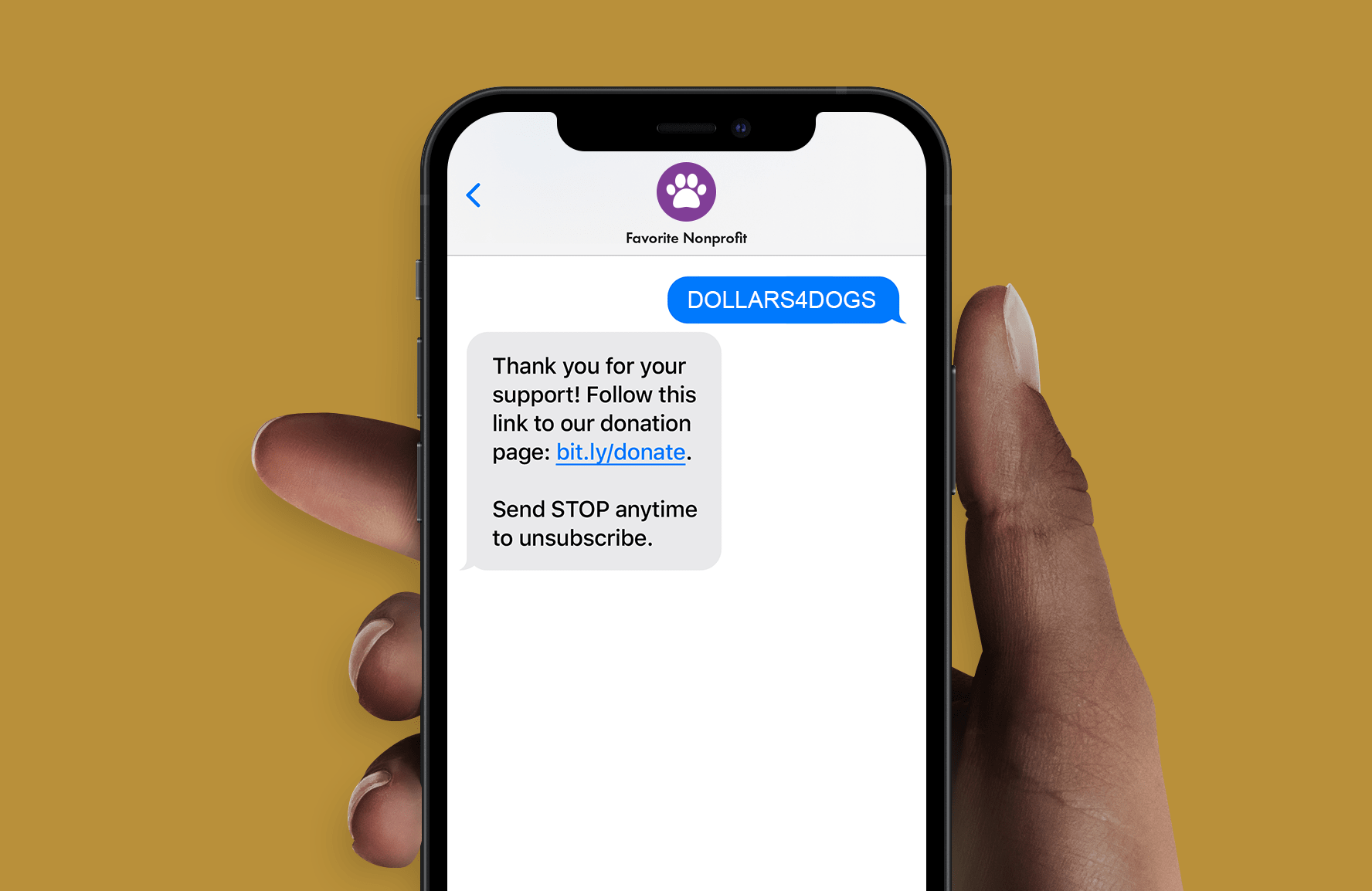
In the past, text-to-give was restricted to the simple act of donating. Your nonprofit would obtain a phone number and text-to-give keyword from a text fundraising provider, then promote that keyword across your marketing channels and encourage donors to text in. Typically, this means running a dedicated, limited-time campaign to promote text donations.
Then, the actual donation process looked like this:
- A donor texts the campaign’s keyword (like “DOLLARS4DOGS” in our example above) to your nonprofit’s designated phone number.
- They automatically receive a text back with a link to your donation page.
- They click the link and complete their donation on your website.
- The donor might receive an automated thank-you text, but that’s where the engagement stops.
The issue with traditional text-to-give campaigns is that they don’t harness the full potential of SMS. They ask donors to send one text, and that’s the end of the conversation. Once the campaign is over, supporters will likely forget about the channel altogether.
Today’s Nonprofit Texting Strategy
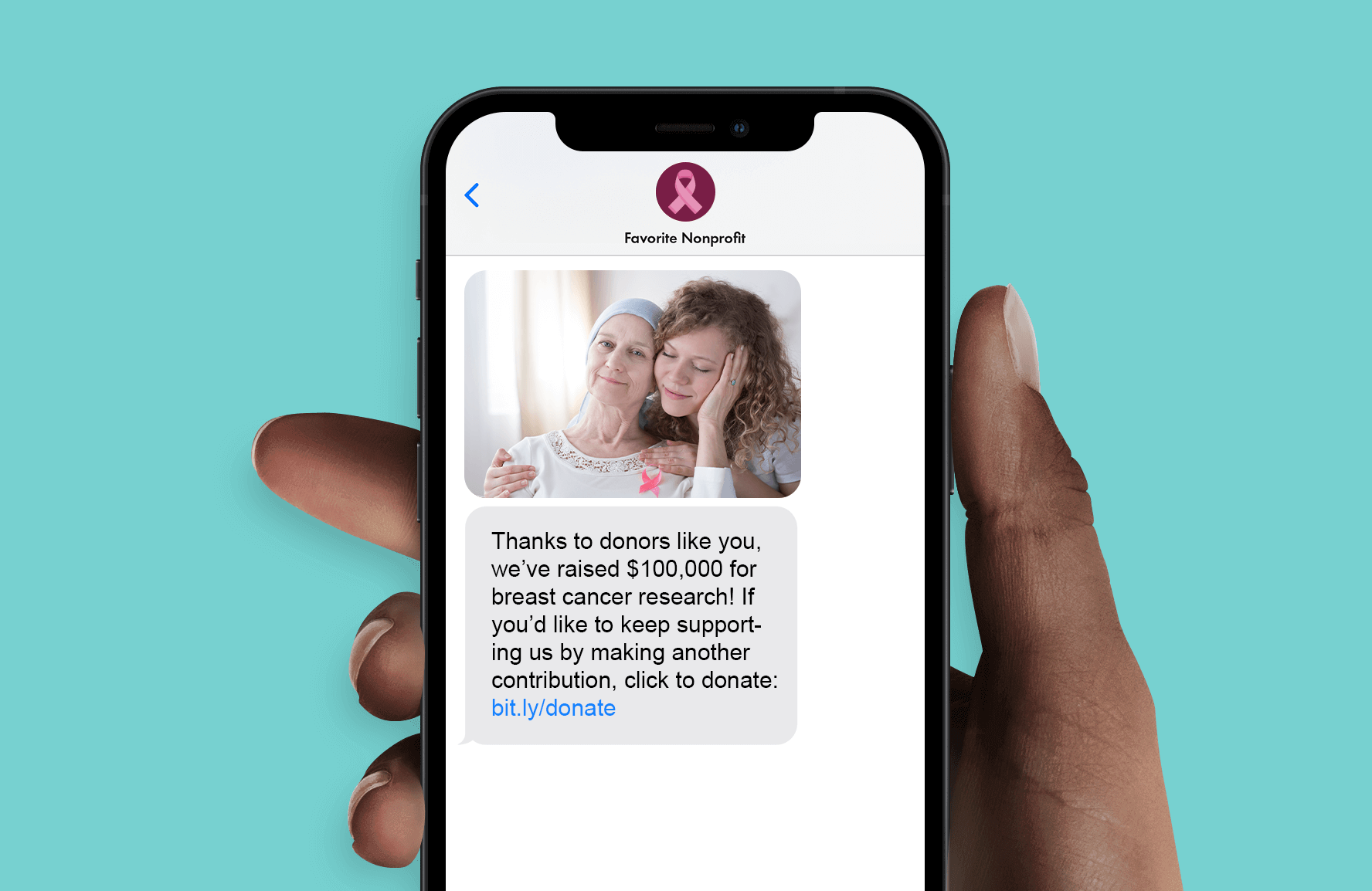
Today, text-to-give is about more than just soliciting donations. Like email, texts should not be used for only single-purpose messages. Rather, use it as an ongoing communication channel to support a variety of mission-relevant goals. Through SMS, your nonprofit can share updates and personalized engagement messages to get to know your supporters and their interests, stewarding them for long-term fundraising rather than only making a single appeal.
With this approach, SMS becomes a powerful fundraising and marketing channel you can leverage anytime to achieve all kinds of goals. Don’t plan standalone text-to-give campaigns—instead, use text-to-donate year-round to:
- Send updates about your projects and campaigns
- Share images and videos about your cause
- Highlight the impact of donations
- Establish a reliable, ongoing revenue stream
- Add mobile giving to your events
- Connect with and steward your donors over time
- Promote GivingTuesday and other urgent campaigns
- Invite supporters to events and volunteering opportunities
- Engage in two-way conversations
- Answer donors’ questions and solicit feedback
Once supporters opt in to receive your nonprofit’s texts (whether by texting you a keyword or signing up on your website), you can send mission-relevant messages at any time. Donors don’t even have to text first!
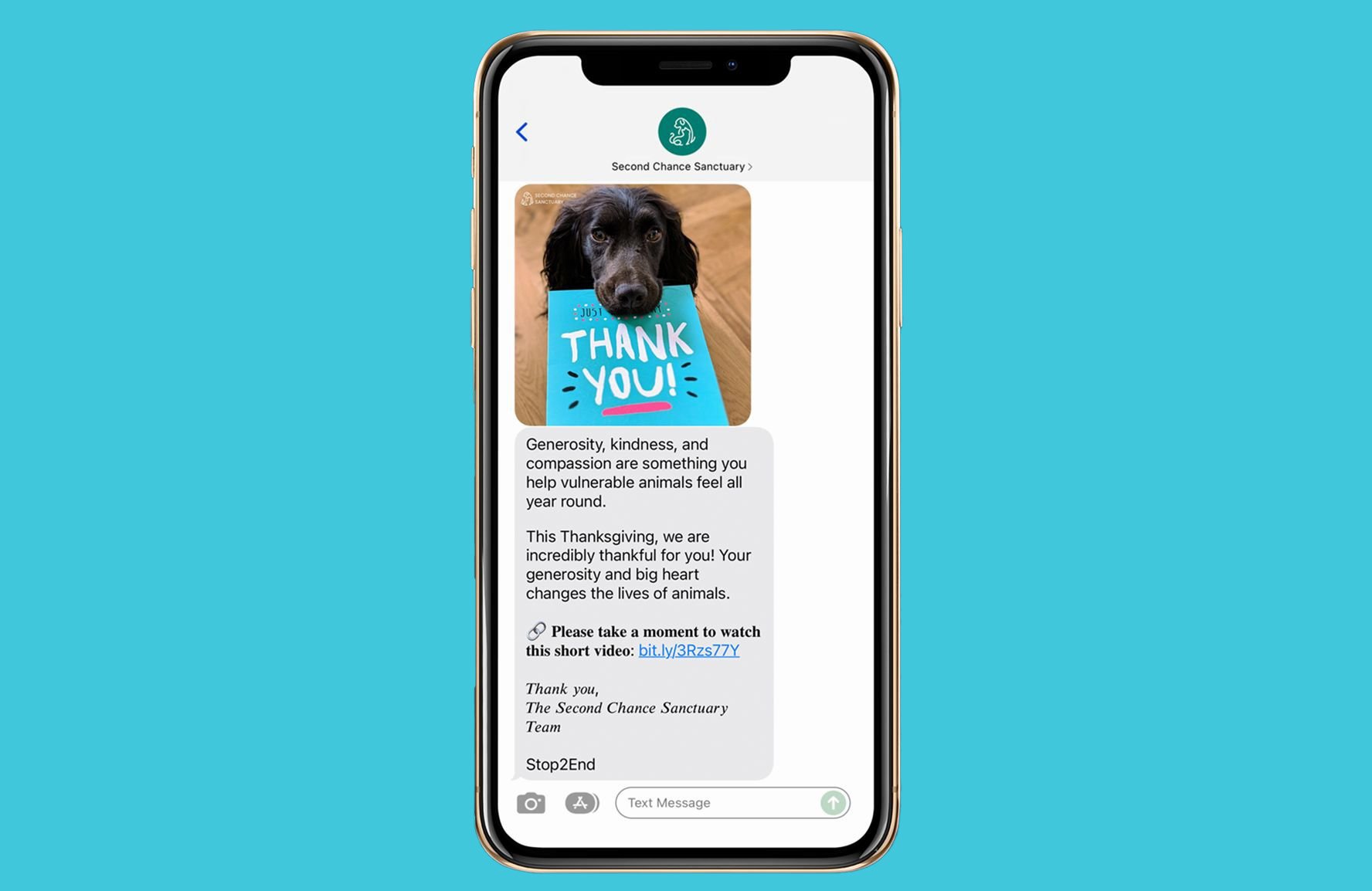
For instance, take a look at our example message above. Without any prompting, the nonprofit shares a quick impact update that includes an image of beneficiaries, a thank-you message, and an opportunity to give again. The recipient might make another donation or reply directly with a question about how the funds will be used. Or, they may just smile at the photo and keep your nonprofit in mind the next time they get an opportunity to donate at work.
Benefits of an Ongoing Text Messaging Strategy
Texting is non-negotiable for nonprofits in today’s fundraising landscape, but you still have options. Why should you choose a holistic, ongoing approach to text fundraising instead of traditional text-to-give campaigns?
There are many benefits, including:
- It’s more convenient for donors. 78% of consumers say that SMS is the fastest way to reach them. When you broaden your texting strategy beyond donation appeals, you can take advantage of this speed and quickly get eyes on your thank-you messages, event invitations, impact updates, and more.
- It keeps your organization top-of-mind. Text messages have a 99% open rate and 90% read rate within just three minutes of sending, which is far superior to other popular communication modes like email, which only has a 20% open rate. Plus, it’s a pretty safe bet that donors who sign up to receive your texts will open them and appreciate the updates.
- The applications for fundraising and engagement are limitless. From coaching peer-to-peer fundraisers to sharing personalized, timely impact updates, there are many ways to engage your audience via text. Take your strategy beyond basic text-to-give appeals, and you can leverage SMS for any supporter-related goal.
- Nonprofit texting consistently yields a high return on investment (ROI). Our 2025 Texting Insights Report found that nonprofits earned $4.38 for every dollar spent on fundraising texts and $3.03 per dollar spent on engagement messages. Most nonprofits prioritized relationship-building texts for the majority of the year. When organizations did make direct asks, the average text-to-give donation was $71.
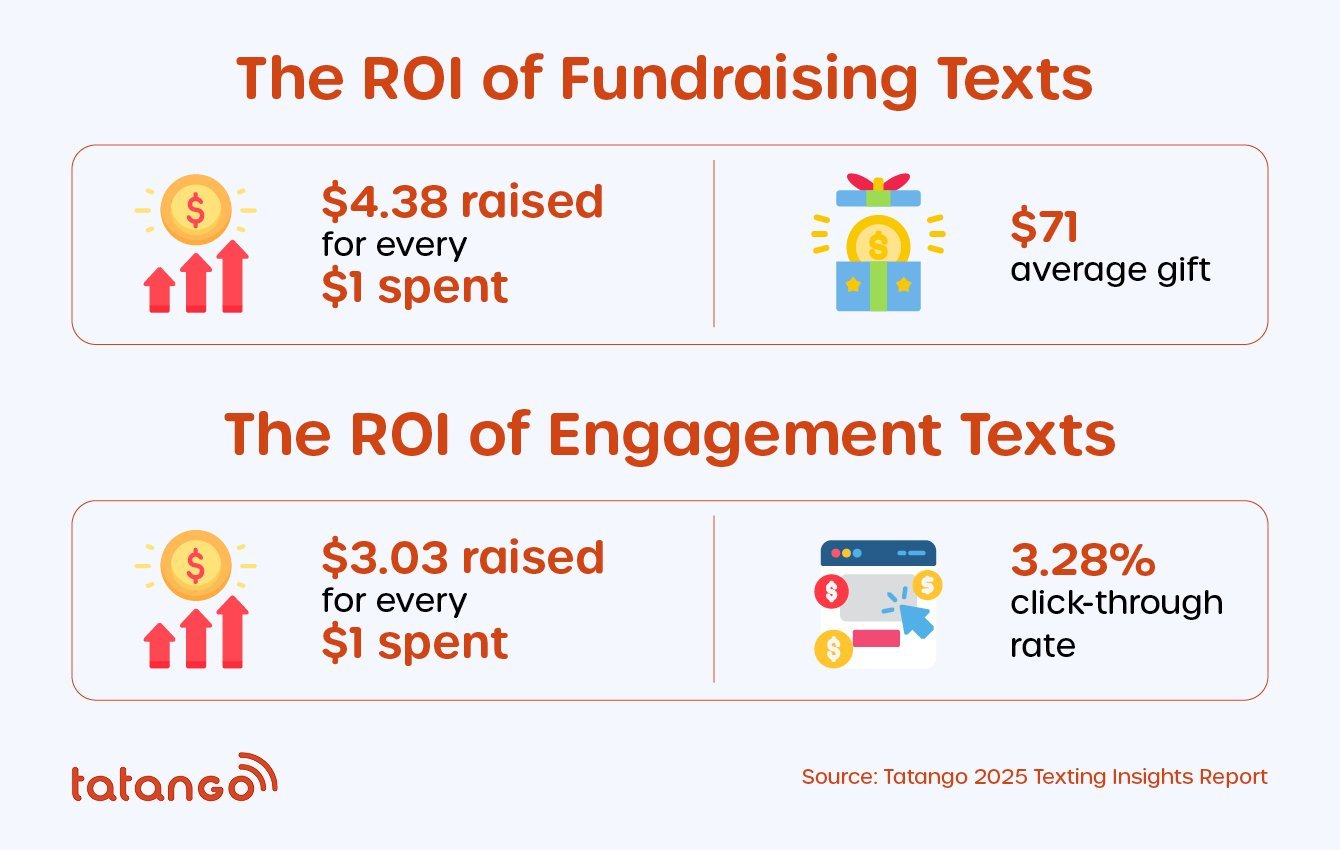
These benefits and statistics illustrate the impact a comprehensive text-to-give approach can have in pushing your nonprofit’s strategic plan forward. If you’re ready to unlock your nonprofit’s full potential and hit the ground running with SMS, take a look at how you can set up text-to-give for your organization.
How to Set Up Text-to-Give For Your Nonprofit
1. Invest in text fundraising software.
Choose a provider that can help your organization promote its fundraisers and spread awareness for its mission. The right software should come with the following capabilities:
- Automation: Easily send off welcome texts for new contacts as soon as they opt-in and thank-you messages to your text-to-give donors right after giving.
- Segmentation: Segment your contact list by donation amount, donation recency, donation frequency, demographics, location, and any other relevant factors.
- Fast message speeds: Your organization should be able to send up to 7 million messages per hour or about 2,000 per second. This way, you can reach supporters quickly with progress updates and donation requests, which is especially helpful when working under tight deadlines.
- Security: Leverage a secure, PCI-compliant text-to-give provider to safeguard your donors’ private information and protect your data from being hacked by unauthorized users.
- Data reporting: Track metrics for each text message to assess your performance, including open rate, click-through rate, number of donations, average donation amount, and total donations raised.
- Integrations with other fundraising tools: Your software should connect with other solutions already in your toolkit to create a two-way flow of data, including your CRM and marketing platform.
- Customer support: Your team shouldn’t have to navigate text-to-give alone. Look for a text-to-give provider that will support you every step of the way to fundraising success.
While investing in text-to-give software may seem like a large expense upfront, the right solution will help you earn back your money and maximize your earnings for years to come.
2. Choose a memorable opt-in keyword.
Your text-to-give provider will assign your nonprofit a 5-digit short code (ex: 23456) or 10-digit long-code (10DLC), and you will create a keyword supporters can use to opt in (like SIGNUP). Then, supporters will simply text this keyword to your short or long code to sign up. This easy step will set them up to receive all incoming messages from your nonprofit.
When choosing an opt-in keyword, make sure it’s:
- Memorable
- Clearly relevant to your organization
- Short enough to type quickly
- Easy to spell
- Free of spaces or special characters
Donors are more likely to type in a short and catchy keyword correctly on the first try, saving them time and keeping your opt-in process as convenient as possible.
3. Grow your contact list.
Once you’re set up to send and receive text messages, you have to let supporters know how to opt in. Leverage these best practices to grow your opt-in list quickly:
- Start with your existing contacts and email them a link to your text opt-in form, or share the keyword so they can opt in on their own time.
- Use multichannel marketing to share your opt-in keyword. Tap into channels like social media, your website, email, and direct mail to increase touchpoints.
- Add a phone number field to your donation form and event registration forms so supporters can easily opt in to texts.
- Offer opt-in incentives like discounted event tickets, early access to information, or other special offers related to your nonprofit’s mission.
The more supporters who give their consent, the more you can steward your donor base with texts. Using your text-to-give software, you can proactively monitor the number of subscribers you earn as well as any unsubscribes.
4. Build solid relationships.
The last thing you want is to bombard supporters who opt in right away with a donation request. This can easily turn supporters off and cause them to ignore your texts altogether.
Instead, strategically steward your supporters and prioritize sending updates about your nonprofit, information on upcoming events, educational texts about the important work you’re doing in the community, and more.
You should also take the opportunity to get to know your subscribers better by sending out a survey asking about their interests. Using this information, you can tailor your message content to their specific preferences and philanthropic interests, making it more likely that they’ll see and engage with your texts.
5. Send tailored donation requests.
Once you’ve solidified relationships with new subscribers, you’re ready to send out a donation request. However, rather than sending every supporter a generic ask for $15, you should tailor your ask to each individual.
For instance, let’s say a supporter who opts in to receive texts has a history of consistently giving around $25 each year to your nonprofit. Instead of asking them for a donation of $5 or $10, which is way below what they’re willing to give, you might ask them to bump up their donation to $35. This is a reasonable ask based on their donation history and challenges them to give more, enabling your nonprofit to increase its impact.
Today’s Text-to-Give Fundraising Best Practices
Explore these best practices to leverage your texts to produce exceptional results year-round.
Make your donation page mobile-friendly
Whenever you send a link to donate, your supporters should be able to easily access your giving page directly from your nonprofit’s text message. That makes it critical to optimize your donation page for mobile devices.
At a minimum, your donation page should have the following mobile-friendly features:
- Limited prompts. Collect only the most important information so your donors can complete the donation process as quickly as possible. Ensure that your prompts ask for donors’ names, contact information, donation amounts, and billing information. You can collect any additional information later as you develop relationships with donors.
- Ample white space. If your donation page looks too cluttered on mobile, donors may get frustrated and abandon the donation process altogether. Ensure that your donation page is responsive across all device sizes and that each element has enough space.
- Clickable prompts and buttons. Donors should be able to easily tap on the prompts/buttons to enter their information.
- Limited (or zero) pop-ups. If your donation page has any pop-ups, these can be difficult to exit out of on mobile devices, especially if they take up the entire screen. Avoid using pop-ups, but if they’re necessary, make sure they’re optimized for mobile devices so users can close them out quickly.
If you’re unsure if your donation page is optimized for mobile devices, run a test by navigating to your website on your phone. If your donation page is difficult to access on a phone, you can optimize it with the help of a web developer or nonprofit content management system (CMS). Many CMS platforms will automatically optimize your entire website, including your giving page, for mobile users.
Write inspiring donor engagement messages.
To get donors to read your messages and donate to your cause, your texts need to be engaging and highlight the value of giving. Include storytelling elements to explain why it’s important for donors to support your mission.
For instance, you might tell a story about a recent project you were able to complete or include a testimonial from someone who benefited from your nonprofit’s services. Appeal to your donors’ emotions and make them passionate about your cause.
A great way to do this is by including impactful visuals, such as photos or GIFs. For example, if you’re an animal welfare organization, consider featuring a photo of a dog or cat that your nonprofit has directly helped:
Determine the frequency of your messages.
You don’t want to text supporters too often, since they might unsubscribe from your messages. While the optimal messaging frequency for your nonprofit will ultimately depend on your goals, we’ve found that organizations typically send 2-3 messages per month. During giving season, however, this ramps up to 7 monthly texts.
Find a balanced frequency for your audience by tracking donor engagement and correlating changes in message frequency to unsubscribe and conversion rates. The right text-to-give platform should make it easy to monitor key metrics like these and others. Experiment with the number of communications you send and modify your approach as needed based on how your donors respond.
Collect and analyze engagement data.
As you start sending text messages, your nonprofit will receive a lot of information about new and existing supporters. Pay attention to important engagement data such as:
- Open rates
- Click-through rates
- Conversions (for donations and other actions, like signing up for an event)
- Donation size and frequency
- Seasonal fundraising totals
- Number of opt-outs
Actively monitor this information so you can understand the effectiveness of your messaging and make adjustments as needed. The right text messaging platform will allow you to find trends in your data and develop an informed strategy to enhance giving.

Express donor appreciation
Your donors are the backbone of your organization, and without them, you wouldn’t be able to push your mission forward. To effectively retain their support, you need to text a thank-you message directly after they give.
Use these tips to help your supporters feel valued and encourage them to donate again in the future:
- Personalize your messages. Greet donors by their first name and reference their most recent donation or involvement.
- Describe the impact of their gifts. Explain the tangible connection between their donation amount and how it will advance your mission. For example, you might say, “Your donation of $50 will provide meals for ten animals in our care this month!”
- Offer additional engagement opportunities. Direct them to sign up for your email newsletter, read the latest blog post on your website, or apply to volunteer.
With the right text messaging platform, you can automatically send these thank-you messages right after donors give. This will reduce your team’s administrative burden, freeing you to focus on strengthening your fundraising strategy.
Tatango: The Top Platform for Modern Text-to-Give
We’ve covered the question: How does text-to-give work? Now, let’s explore the top text messaging platform designed to help your nonprofit maximize its fundraising results: Tatango.
Tatango is the leading nonprofit text messaging provider on the market. Since its founding in 2007, Tatango has helped organizations raise over $650million for their causes. And, these organizations report an average ROI of 500%, allowing them to connect directly with their supporters and see value year after year.
As a scalable, flexible platform designed to meet the specific needs of nonprofits, Tatango comes with the following capabilities:
- Personalization and segmentation tools to customize your messages to various audiences and donor types.
- Automation so you can power off high-impact messages with ease.
- MMS messaging functionality to add valuable visuals, GIFs, emojis, and more that will catch your donors’ eye and inspire giving.
- Administrative control and security so only authorized users can access your campaign data and send messages.
- Powerful integrations so your data can smoothly flow between platforms.
- Advanced reporting capabilities so you can get a bird’s-eye view of how your text-to-give fundraising campaign is performing at any point and make adjustments accordingly.
- World-class support from an experienced and knowledgeable team of SMS fundraising experts.
Backed by an all-in-one nonprofit text messaging platform like Tatango, you can boost your ROI, solidify supporter relationships, and take your organization to new heights.

Text-to-Donate FAQs
What’s the difference between text-to-give and text-to-donate?
Many nonprofits use text-to-give, text-to-donate, and text fundraising interchangeably. However, some service providers use the term “text-to-give” to refer to a donation process where gift amounts are automatically added to supporters’ phone bills. In these cases, wireless carriers often take a percentage of contributions.
Since the terms are often used synonymously, don’t get too bogged down in the specific terminology. Instead, focus on finding a provider that offers your nonprofit and donors as much flexibility as possible.
For example, Tatango allows you to create a custom keyword with a shortcode (e.g., 34-567) or a 10-digit long-code, send mobile-friendly links to your donation page or volunteer sign-up form, segment your audience for personalized engagement, and learn from your SMS data with robust insights and analytics.
What kinds of organizations use text-to-give?
Nonprofits in a variety of sectors can benefit from adding text-to-give to their fundraising strategy. These include:
- Environmental conservation organizations
- Health organizations
- Animal welfare organizations
- Social service nonprofits
- Higher education institutions
Since text-to-give is a convenient and fast way to reach supporters, this fundraising tool is especially helpful for nonprofits that need to raise funds quickly to serve their communities.
Is text-to-give secure?
Whenever you tap into a new fundraising channel, it’s critical that you take every step to protect your donors’ private information and ensure that their funds can safely be transferred to your nonprofit. You can safeguard your data by working with a text-to-give provider with the following security features:
- SOC-2 compliance: SOC-2 refers to a security framework that maintains the privacy of your donors’ data. This means that all information stored by your text-to-give software will be protected from unauthorized access, cybersecurity leaks, and other vulnerabilities. As a result, your organization will benefit from enhanced donor trust, leading to increased giving.
- Two-factor authentication: Think of two-factor authentication as a second line of defense against hackers after your password. When you attempt to log in with your username and password, you’ll also have to type in a special code sent to your mobile phone. This extra step only takes a few more seconds and is an effective obstacle against unauthorized users logging into your account and accessing your data.
- Secure sending: Secure sending requires a user to re-enter their password before they can send out any text messages from your account. This is another layer of protection, ensuring that the text messages your recipients receive have been properly vetted and were intended to be sent out.
- Automated logout: If you’re logged into your text message provider on your computer or mobile device but haven’t had any activity in a while, you’ll automatically be logged out so your account is protected from any unauthorized users.
The right text-to-give partner checks these boxes and more, so you can rest assured that your text messaging campaign adheres to all best practices.
Taking Your Text-to-Give Strategy Into the Future
Text-to-give fundraising is one of the best ways to get supporters excited about your cause and boost your revenue long-term. To seamlessly incorporate texts into your strategy, partner with a dynamic text fundraising solution like Tatango.
Recognized as the #1 SMS software for fundraising, Tatango has a proven track record in helping organizations raise millions of dollars for the causes they care about. If you’re interested in maximizing donations and achieving your text-to-give goals, contact us and let our experts help you design a campaign that will increase your ROI.
Eager for more information on how to build and sustain a successful text fundraising campaign? Check out these additional resources:
- SMS Short Codes for Nonprofits: How to Get Your Own: Learn more about SMS short codes and how the right text messaging provider can walk you through getting your campaign set up.
- Nonprofit Text Messaging: How to Reach Your Audience: Eager for more best practices to run an engaging text messaging campaign? Check out this guide to perfecting your text messaging strategy.
- 21 Text Donation Messages: Examples + Easy Templates: Explore our inspiring roundup of nonprofit text messaging examples to inform your content strategy.
 Mike Snusz, Director of Nonprofit Customer Experience
Mike Snusz brings nearly two decades of digital fundraising expertise to his role as Director of Nonprofit Customer Experience at Tatango, the industry’s leading text messaging platform for nonprofits. A recognized thought leader in SMS fundraising, Mike regularly speaks at national conferences and contributes insights to resources like the Texting Insights Report and other nonprofit publications.
Before joining Tatango, Mike spent 15 years at Blackbaud, where he led a team of digital consultants helping nonprofits optimize their online giving, email marketing, peer-to-peer fundraising, and monthly giving programs.
He began his nonprofit career in Buffalo, NY, managing the Ride For Roswell from 2003 to 2005—an experience that continues to shape his commitment to helping mission-driven organizations thrive in a digital world.
