
We often hear marketers ask, "Can I legally text message my customers?"
This question is usually asked by brands new to SMS marketing, who have already collected their customers' mobile phone numbers, and want to know if they can now use those numbers for text message marketing.
First, some background on the law that decides whether you can text your customers.
Telephone Consumer Protection Act
That law is the federal Telephone Consumer Protection Act (TCPA), which is governed by the Federal Communications Commission (FCC). While you may hear of organizations like the CTIA or Mobile Marketing Association when researching best practices for SMS marketing, the TCPA is the main federal law regarding text messaging customers, and some states have their own.
The TCPA’s rule for mobile numbers you’ve already collected from your customers is short. To send them marketing texts, you need their prior express written consent, and when you collect their mobile phone numbers you have to clearly and conspicuously disclose at least the following two things to them:
- By participating, they consent to receive text messages sent by an automatic telephone dialing system.
- Consent to these terms is not a condition of purchase.
What does “clear and conspicuous” mean? It means that the disclosures were plainly displayed in close proximity to wherever you were asking customers for their mobile phone numbers. If you did not disclose the two things above to customers when they gave you their mobile phone numbers, or you didn’t disclose those things in a “clear and conspicuous” manner, then you cannot text message them.
Here is an example of clear and conspicuous consent:
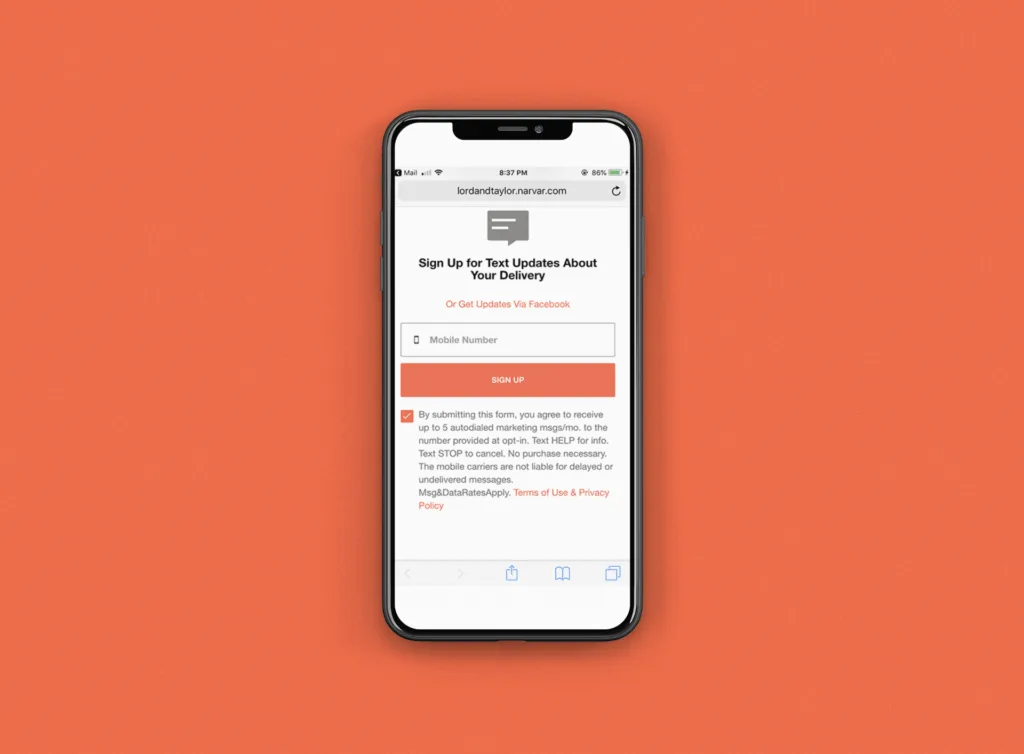
When most businesses initially collect their customers' mobile phone numbers, they either do not disclose the above two things to their customers, or do not do so in a “clear and conspicuous” manner.
This usually leads to businesses asking if they can text message their customers to get their permission. The answer is no. If you did not disclose the above two things when collecting your customers' mobile phone numbers, or didn’t disclose those two things in a “clear and conspicuous” manner, then you can not text message them. Period.
A Jiffy Lube franchisee texted customers a promotional offer without their written consent, and settled the resulting lawsuit for up to $47M, one of the largest text message spam settlements of its time.
Risks of Texting Customers Without Consent
So what can happen if your business text messages customers, even though you didn’t disclose the above two things when you collected mobile phone numbers, or didn't do so in a “clear and conspicuous” manner? One of three things can happen:
1) Your customers may be granted a private right of action in a local court. In non-legal speak, this means that each text message recipient can sue your business for each and every message they received.
An angry text message recipient can claim damages of up to $500 for each text message they receive.
If the court finds that your business willfully or knowingly violated the TCPA, the court can triple the amount of damages, which means that your business could be sued for up to $1,500 per text message.
2) A state may initiate civil action against your business on behalf of its citizens.
3) Complaints may be filed with the Federal Communications Commission, which has the power to assess penalties against your business for violating the TCPA.
So only text customers who have opted into your campaigns knowingly from the start.
For more on collecting your customers' phone numbers and staying TCPA-compliant, see these free SMS marketing guides: